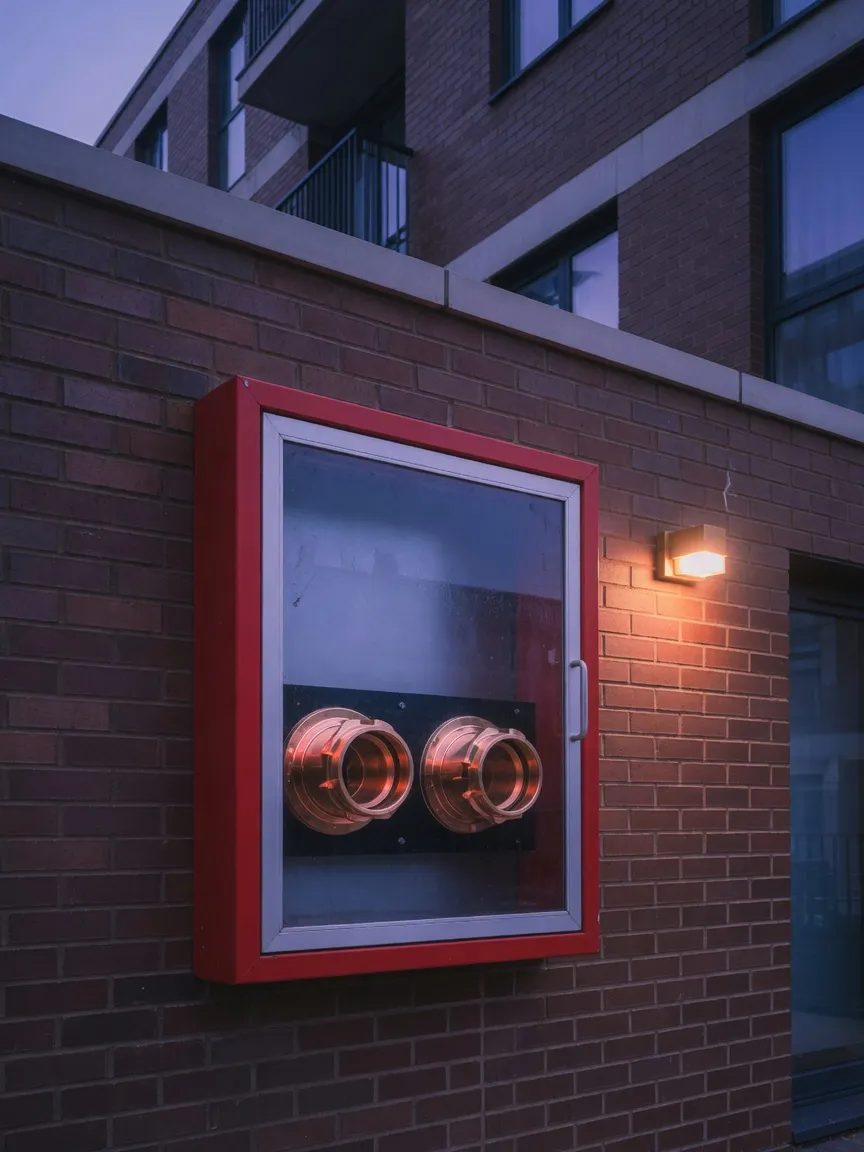
The firefighters’ main,
proven ready.
A dry riser is the main firefighters charge with water when they arrive, and it only works if every inlet, landing valve and joint holds pressure on the night. Gemini AMPM tests dry risers to BS 9990: the annual pressure test, the six-monthly visual inspection, the repairs in between, and new installations where a building needs one, certificated every time.
Annual wet test,
six-monthly eyes-on.
BS 9990 sets the maintenance rhythm: a visual inspection every six months (cabinets, inlets, landing valves, signage, vandalism and missing blank caps), and an annual pressure test where the riser is charged with water and proven to hold working pressure, outlets checked and the system drained down properly afterwards. The duty to keep the riser maintained sits with the responsible person under article 17 of the Fire Safety Order, and it is one of the first records a fire safety inspector asks a residential block or commercial landlord to produce.
Most defects we find are small and cheap when caught: missing blank caps, seized or leaking landing valves, vandalised inlet doors, and corrosion at the air valve. Left alone they become the kind of failure that only reveals itself when the brigade connects in anger. Testing with us includes minor remedials on the day where possible, and a priced schedule where not.
Scoped, delivered,
evidenced.
- Annual pressure testing: riser charged, proven at working pressure, outlets checked, drained down and certificated to BS 9990.
- Six-monthly visual inspections: inlets, landing valves, cabinets, caps and signage checked, defects photographed and priced.
- Repairs & parts: valves, caps, cabinet doors and pipework corrosion put right before they become failures.
- Installation & alterations: new risers designed, routed and commissioned, including in occupied and awkward buildings.
- Certificates & records: dated evidence for the responsible person’s file, issued after every test.
New risers, awkward
buildings, no drama.
We also design and install dry risers, including in the buildings where it is hardest: occupied, nearly finished, or architecturally unforgiving. The proof is the Troubadour Theatre at Canary Wharf: a riser designed, routed and certified through a nearly complete venue around live rehearsals, with zero remedials at inspection. Design and routing to BS 9990, coordination with the fire strategy, and commissioning certificates into the building’s records.
Dry risers rarely live alone: the same visit discipline covers extinguishers, alarm servicing and the rest of the building’s fire assets, so a block’s statutory calendar can sit with one contractor and one set of certificates. For landlords and managing agents, that consolidation is usually the difference between records that exist and records that are findable.
Common questions on
dry risers.
How often must a dry riser be tested?
BS 9990 expects a visual inspection every six months and a wet pressure test annually, where the riser is charged with water and proven to hold working pressure. The Fire Safety Order's article 17 maintenance duty is what makes that regime effectively mandatory for the responsible person.
What buildings need a dry riser?
Building Regulations guidance requires fire mains in buildings above 18 metres, with dry risers the standard provision up to 50 metres and wet risers above that. Many lower buildings carry them too, where the design or the fire strategy called for one: if the cabinet is on the wall, the maintenance duty applies.
What does the annual test involve?
We connect to the inlet, charge the riser with water, bring it to working pressure and hold it while checking every landing valve and joint, then drain the system completely and prove the air valve. The certificate records the pressure held and any defects found, and the building goes back to ready.
What are the most common failures?
Missing or stolen blank caps, leaking or seized landing valves, vandalised inlet cabinets and corrosion, most of them minor if caught at the six-monthly visual. The expensive version is finding them during a fire, which is the whole argument for the regime.
Can you take over testing from another contractor?
Yes: takeover starts with a full test and condition survey so you get an honest baseline, then the six-monthly and annual cycle runs on a planned schedule with certificates issued every time.
Tell us about
the building.
A named engineer comes back within 24 hours, not a call centre. Site surveys are free for commercial premises, no obligation.
Talk to us about
dry risers.
A named engineer, not a call centre, comes back within 24 hours. Tell us the building and what you’re dealing with, and we’ll scope it properly.