If the room leaks,
the system fails.
Gas suppression only works if the gas stays put. A door-fan integrity test proves, without discharging a single cylinder, that your enclosure will hold its agent concentration for the required time. Gemini AMPM tests to ISO 14520 and BS EN 15004 Annex E, finds the leaks, and gives you the pass certificate your insurer wants to see.
One fan.
The whole enclosure measured.
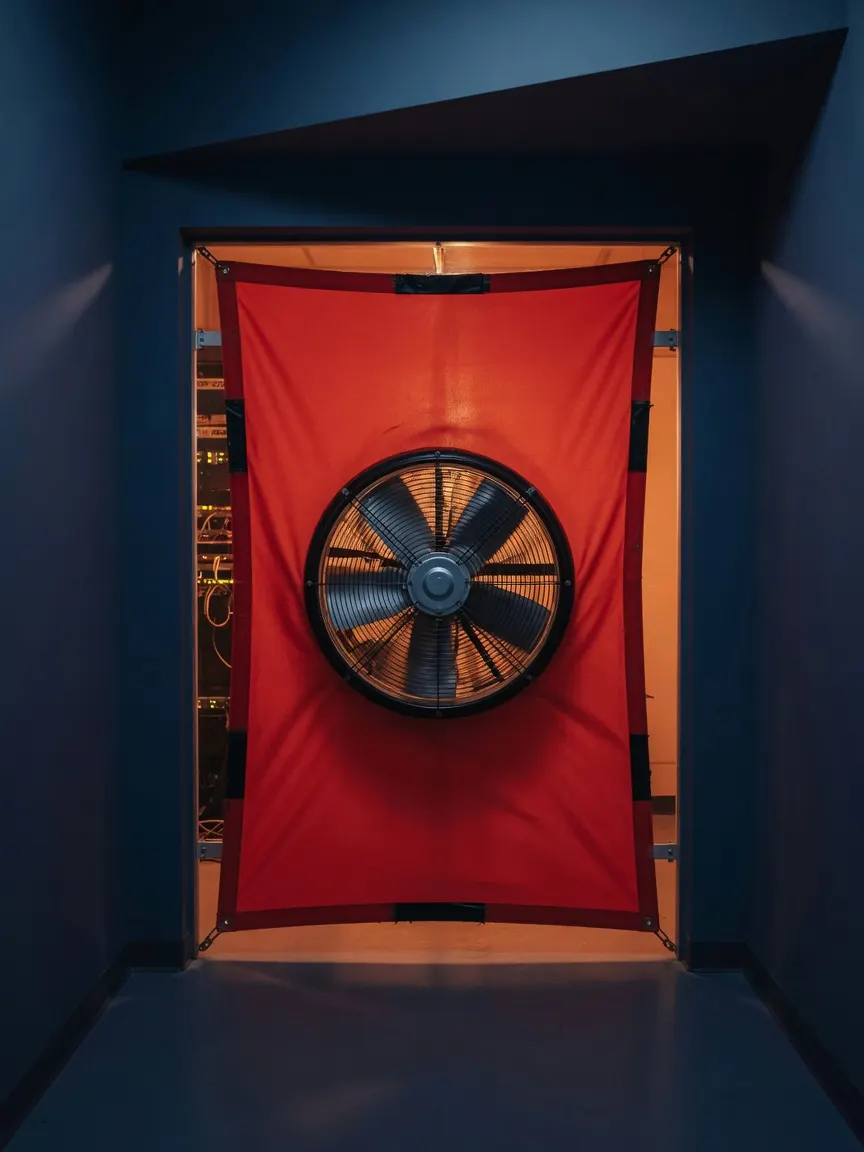
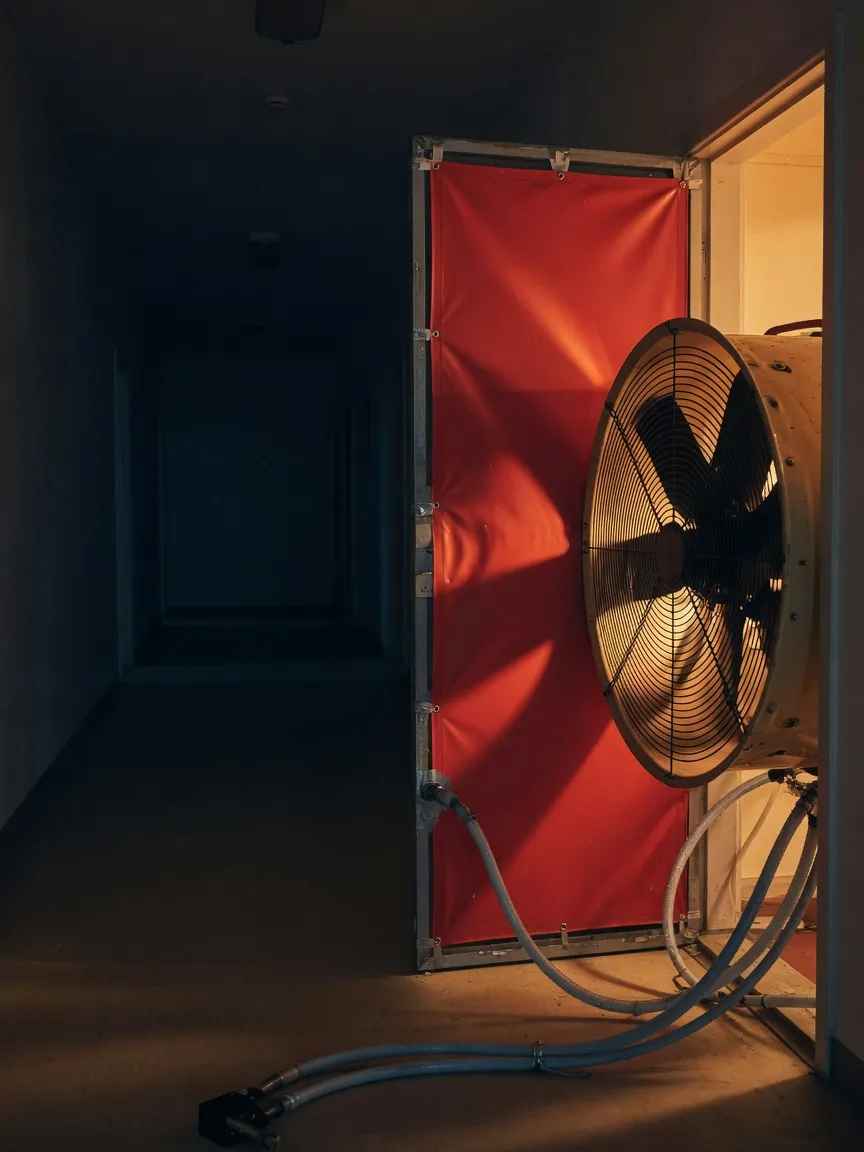
The door fan pressure test is simple in concept: a calibrated fan is mounted in the doorway of the protected room, and the space is pressurised and depressurised in turn. From the airflow needed to hold each pressure, we measure the enclosure’s total leakage area: every unsealed cable penetration, gappy door and forgotten void, expressed as one number. Software then converts that leakage into a predicted hold time: how long the room will keep its agent concentration above the minimum at the protected height.
The method comes straight from Annex E of BS EN 15004-1 and ISO 14520-1, and it is the accepted alternative to discharging agent to prove retention. Typically ten minutes of hold time is required. No gas is released, nothing shuts down, and the test is normally complete within a couple of hours. It is the cheapest question you will ever ask of a suppression system: would it actually have worked?
Scoped, delivered,
evidenced.
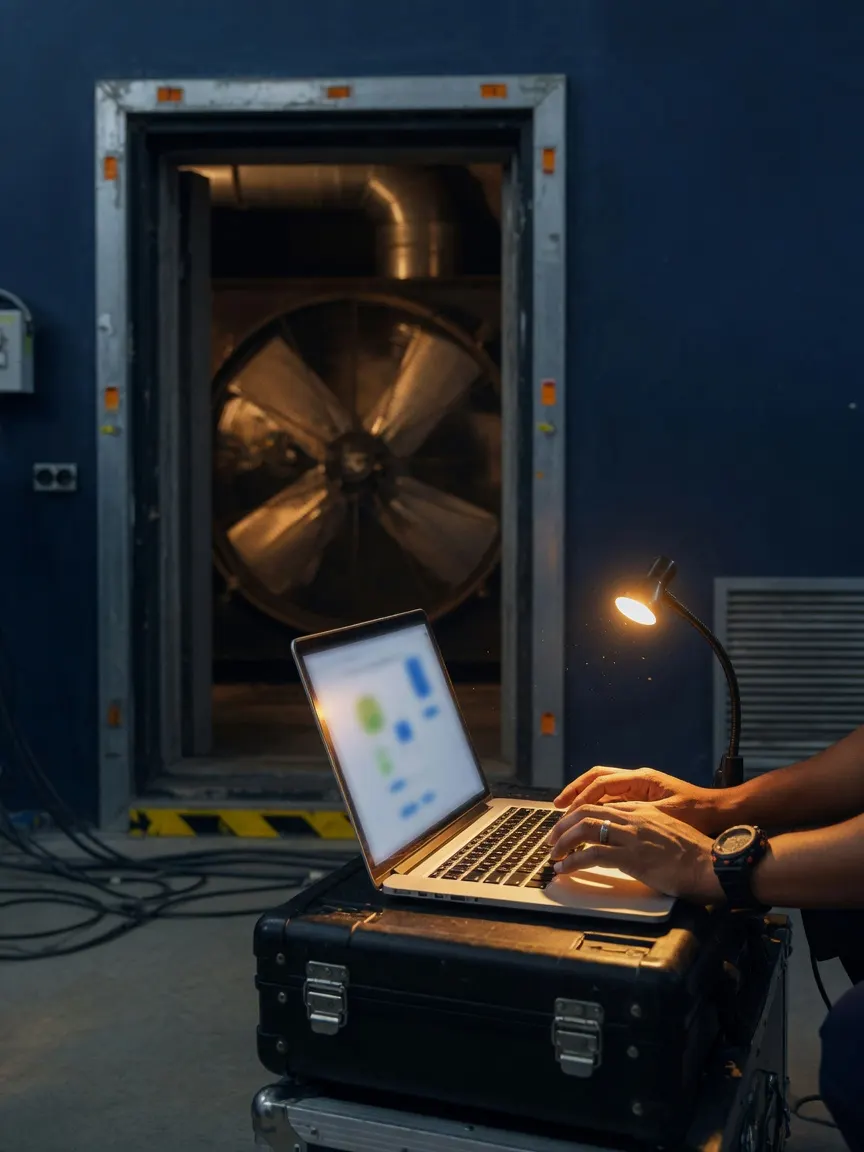
- Door-fan testing: enclosure integrity measured to Annex E of BS EN 15004-1 and ISO 14520-1, without releasing agent
- Hold-time prediction: measured leakage converted into the retention time your agent will actually achieve at the protected height
- Annual retests: scheduled testing that keeps your insurer records current and your cover conditions met
- Post-works testing: retests after cabling, partition, door or ceiling changes that alter the enclosure’s leakage
- Remediation in-house: leak sealing and firestopping by our FIRAS-certificated passive fire team, then a confirmatory retest
- Clear reporting: pass certificates, leakage findings and remediation records issued for your compliance file
Annually. And after
anyone touches the fabric.
Test at commissioning, then annually as standard practice, and again after any change to the enclosure. The standard asks for the enclosure to be checked at least every 12 months and retested whenever a change cannot be ruled out by inspection; in a working room, it rarely can. New cabling punched through a wall, replaced doors, altered partitions, revised ceiling voids: each one changes the leakage picture, and none of them announces itself to your suppression system. Most insurers expect current integrity test records as a condition of cover, and an out-of-date pass is little better than none.
A failed test is not a crisis: it is a to-do list. Our report identifies the leakage paths and the shortfall, and because Gemini runs a FIRAS-certificated passive fire protection team, the remediation (sealing penetrations, dropping in door seals, closing dampers and voids) can be done by us and retested, often in the same visit. You end with a pass certificate and records your insurer can file.
It is almost never
the walls.
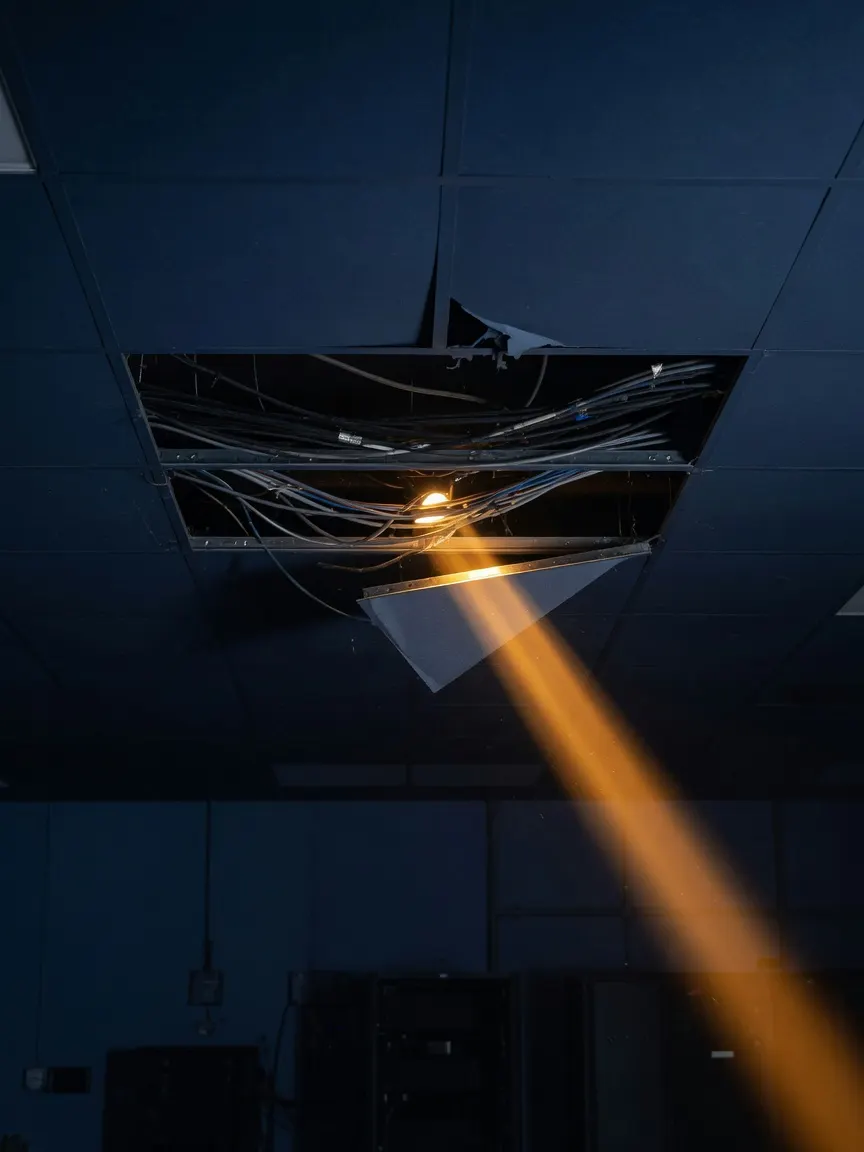
Enclosures rarely fail because of the walls. They fail at the holes people made in them: cable and containment penetrations sealed with the wrong product or with nothing at all, redundant openings left behind after a strip-out, door undercuts and perished seals, dampers that no longer close properly, and the void above the ceiling or below the floor that quietly connects the protected room to the one next door. A room can look immaculate and still leak badly.
The pattern is predictable enough that we work through it in order, which is why a test normally ends with a specific list rather than a bare number. Structured cabling changes are the most common single cause we find: a routine desk move that put four new penetrations through a compartment wall, with nobody on site aware that the suppression in the room below depended on that wall staying sealed.
A certificate your
insurer will accept.
The deliverable is not the fan, it is the record. Each test produces the measured leakage area, the predicted hold time against the required minimum, an unambiguous pass or fail, and photographs of the leakage paths we found. That is what an insurer, an auditor or an incoming maintenance contractor needs to see, and it is what turns a suppression system from an assumption into evidence.
We schedule integrity testing alongside the annual suppression service wherever possible, so one visit covers both and the paperwork arrives together. If your records are out of date, or you have never actually seen a hold-time figure for a room the business depends on, that is the place to start. Ask us to test it and you will at least know where you stand.
Common questions on
room integrity testing.
How often does a room integrity test need to be done?
At commissioning, then whenever a change to the enclosure cannot be ruled out. ISO 14520 and BS EN 15004 ask for the enclosure to be checked at least every 12 months and the door-fan test repeated if that check cannot establish that nothing has changed; we retest annually as standard practice, and most insurers treat current test records as a condition of cover. On top of the annual cycle, retest after any work that touches the enclosure: new penetrations, replaced doors, moved partitions, changes above the ceiling or below the floor. If the fabric changed, last year’s pass proves nothing.
What happens if our room fails the test?
You get specifics, not just a fail. The report quantifies the leakage, identifies the likely paths and states the predicted hold time against the required minimum. Remediation is usually unglamorous (sealing cable penetrations, fitting door drop-seals, closing off voids and dampers), and our FIRAS-certificated passive fire team can carry it out and retest, often within the same visit. Most failed rooms can be brought to a pass quickly.
Does the test disrupt the protected room?
Barely. The door fan needs the doorway and a stable enclosure for the duration (typically a couple of hours), but no agent is discharged, no equipment is powered down and the room’s services keep running throughout. It is dramatically less disruptive than the alternative it replaced, a full discharge test, and vastly less expensive. Most clients schedule it alongside a routine suppression service visit to save a mobilisation.
What hold time does our room actually need?
It is set by the system design rather than by a universal figure, though ten minutes at the protected height is the common requirement and the one most systems are built around. The protected height matters as much as the duration: concentration has to hold up to the highest point where a fire could realistically start or where equipment needs protecting, not merely at floor level. Your original design documents should state both. Where they have been lost, which is common on older systems, the test plus a design review re-establishes what the room is supposed to achieve.
Do we still need a test if nothing has changed?
Almost certainly, for two reasons. The first is that enclosures change without anyone recording it: cabling pulls, ceiling works and door adjustments are routine, and none of them generates a note to the suppression file. The second is that most insurers treat a current integrity certificate as a condition of cover, and an expired pass tends to be treated much the same as no pass at all. Set against the value of the room it protects, the annual test is one of the cheapest checks on the building.
Can the test be done while the room stays in use?
In most cases yes. The door fan occupies one doorway for a couple of hours and the enclosure needs to stay stable while the readings are taken, but nothing is discharged, nothing is powered down and the room’s services run throughout. The practical constraint is usually traffic through that door rather than the equipment inside it. For data halls and control rooms we schedule around shift patterns and change windows: we would far rather move the visit than ask you to take a risk with a live space.
Tell us about
the building.
A named engineer comes back within 24 hours, not a call centre. Site surveys are free for commercial premises, no obligation.
Talk to us about
room integrity testing.
A named engineer, not a call centre, comes back within 24 hours. Tell us the building and what you’re dealing with, and we’ll scope it properly.