Oxygen down. Fire out.
Nothing left behind.
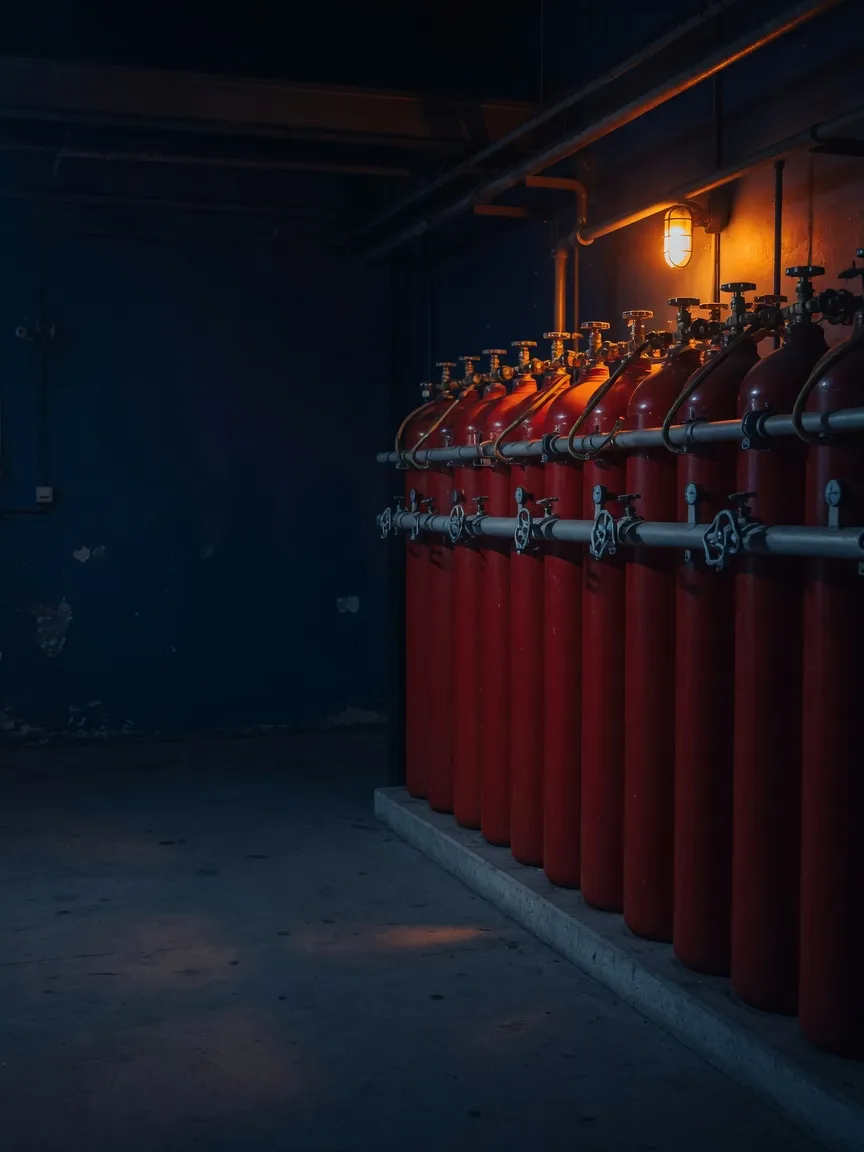
Inert gas puts a fire out by taking its oxygen away, and leaves nothing else behind. Gemini AMPM is an approved Fike installer, delivering ProInert® IG-55 systems: a blend of argon and nitrogen that suppresses fire with no residue, no thermal shock and no damage to the equipment it protects. Safe for occupied spaces at design concentration.
Take away the oxygen.
Keep everything else.

IG-55 is a 50/50 blend of argon and nitrogen, two gases already in the air around you. On discharge it lowers the oxygen in the protected space from around 21% to roughly 12-13%: too little to sustain combustion, but calculated under BS EN 15004 so occupants can still evacuate safely. There is no fog, no residue, no corrosive by-product and no thermal shock to hot equipment. The gas simply disperses when you ventilate.
As an approved Fike installer, Gemini fits ProInert®, an IG-55 system with a pressure-regulating discharge valve. Instead of an aggressive initial surge, the agent flows into the room at a controlled, steady rate. That means lower peak pressures on the enclosure, smaller relief vents and less strain on the building fabric. And because inert gas travels well in pipework, cylinder banks can sit well away from the space they protect.
Scoped, delivered,
evidenced.

- IG-55 systems: argon and nitrogen blended 50/50, designed and installed to BS EN 15004 and ISO 14520
- Fike ProInert®: approved installer status, with regulated discharge for lower peak pressures and smaller relief vents
- Occupied-space safety: design concentrations that stop combustion while remaining safe for people evacuating the room
- Clean suppression: no residue, no thermal shock, electrically non-conductive and harmless to servers, media and archives
- Environmental certainty: naturally occurring gases with zero GWP and no fluorinated chemistry facing regulatory pressure
- Proven delivery: IG-55 suppression delivered at Peterborough Court & Daniel House in the City of London
For the rooms
you can’t switch off.

Inert gas is the default choice where the contents matter more than the carpet: data centres, comms rooms, switchrooms, archives, heritage stores and laboratories. Water would wreck them. Powder would too. IG-55 suppresses the fire and leaves servers running, documents dry and downtime short. And because argon and nitrogen occur naturally, the agent has zero ozone depletion potential, zero global warming potential and no fluorinated chemistry to worry about later.
We have delivered IG-55 at scale, including the Peterborough Court & Daniel House project in the City of London. Design, installation, commissioning and ongoing maintenance all come from one team, to BS EN 15004 and ISO 14520, with 24-hour named-engineer response behind every system we hand over. One accountable contractor, for the room your business cannot lose.
The agent is only
half the design.
Sizing the agent is the straightforward part. An inert system stands or falls on the enclosure around it, because IG-55 has to stay at concentration long enough to matter, typically ten minutes at the protected height. That is proven by door-fan integrity testing rather than assumed, and a room that leaks will fail however carefully the cylinders were calculated. It is the single most common reason a system that looks compliant on paper would not have worked.
Inert systems also displace a real volume of air, so the enclosure has to shed the resulting overpressure without damaging doors, ceilings or partitions. Pressure-relief venting is calculated as part of the hydraulic design, and it is where the regulated ProInert® discharge earns its keep: a steadier flow means a lower peak, which means smaller vents and less intrusion into a finished space. Cylinder banks can then sit in a plant room or corridor well away from the protected area, which is often what makes inert gas workable in a building with no space to spare.
One of these choices
is getting harder.
The practical case for inert gas has strengthened as the regulatory position on fluorinated agents has hardened. IG-55 is argon and nitrogen: no fluorine chemistry, no global warming potential to offset, and nothing sitting on a phase-down schedule. Halocarbon agents remain entirely legal and are the right answer in plenty of rooms, particularly where cylinder space is the binding constraint, but they sit inside a regulatory conversation that inert gas simply does not.
We design and maintain both, and we will tell you which one your room actually wants rather than which one we would rather sell. Where space allows and the system is expected to stay in service for decades, inert gas removes a category of future risk. Where the cylinder footprint decides the job, a halocarbon system may be the better engineering answer. Our note on PFAS restrictions and clean-agent suppression sets out where the regulation currently stands.
Common questions on
inert gas (ig-55).
Is it safe to be in the room when IG-55 discharges?
Yes, within the limits the design sets. BS EN 15004 fixes design concentrations so oxygen falls low enough to suppress fire but stays within safe exposure limits for the agent, and pre-discharge alarms with time delays give occupants clear warning to leave. IG-55 produces no toxic breakdown products and no fog to obscure exits. You should still evacuate on the alarm, but the system is engineered so you can.
What makes Fike ProInert different from other inert systems?
Conventional inert systems discharge with a violent initial spike, which forces large pressure-relief vents on the room. ProInert’s valve regulates cylinder pressure through the discharge, so the agent enters the enclosure at a steady rate. Peak pressures drop, relief venting shrinks, and installation in finished buildings gets simpler and cheaper. Gemini is an approved Fike installer, so design, hardware and warranty all line up under one contractor.
How quickly can the room be used again after a discharge?
Quickly, compared with almost any alternative. Once the fire is confirmed out, the space is ventilated to restore normal oxygen levels and can then be reoccupied: there is no residue to clean, no water to extract and no chemical film on equipment. The bigger job is recharging the cylinders, which we arrange as part of our repair and recommissioning service so protection is restored without drama.
How much space does an IG-55 cylinder bank need?
More than an equivalent halocarbon system, and that is the main trade-off. Inert gas is stored as a compressed gas rather than a liquid, so protecting the same volume takes more cylinders. The offset is that inert gas travels well through pipework, so the bank does not have to sit beside the room it protects: a plant room, a basement or a corridor cupboard some distance away is usually workable. We fix the cylinder location at survey, because it is the constraint most likely to reshape the design, and it is far cheaper to solve on a drawing than on site.
Does an inert gas system need pressure-relief venting?
Yes. Discharging a large volume of gas into a sealed room raises its pressure, and without a calculated relief path that overpressure goes into the doors, ceiling and partitions instead. Relief venting is sized as part of the hydraulic design rather than added afterwards. Because ProInert® regulates the discharge instead of releasing it in a single surge, the peak pressure is lower and the vent required is smaller, which matters a great deal when the protected room is a finished space in an occupied building.
Is inert gas affected by PFAS or F-gas restrictions?
No. IG-55 is a blend of argon and nitrogen, both naturally occurring, with no fluorinated chemistry, no ozone depletion potential and no global warming potential. It sits outside the F-gas phase-down and outside the PFAS restriction proposals now shaping the outlook for some halocarbon agents. That is not a reason to strip out a working halocarbon system, which remains legal and effective, but it is a good reason to think hard about agent choice on anything being designed today for a long service life.
Tell us about
the building.
A named engineer comes back within 24 hours, not a call centre. Site surveys are free for commercial premises, no obligation.
Related insights.

Inert gas vs chemical agent fire suppression: which does your risk need?
Both are clean agents and both put the fire out, but they are very different to own. Floor space, discharge, room integrity, refills and PFAS compared.
Gas suppression vs sprinklers for data centres: which protects what
Inert gas, chemical agent, or sprinklers: a clear comparison framework for IT and mission-critical environments.
Talk to us about
inert gas (ig-55).
A named engineer, not a call centre, comes back within 24 hours. Tell us the building and what you’re dealing with, and we’ll scope it properly.