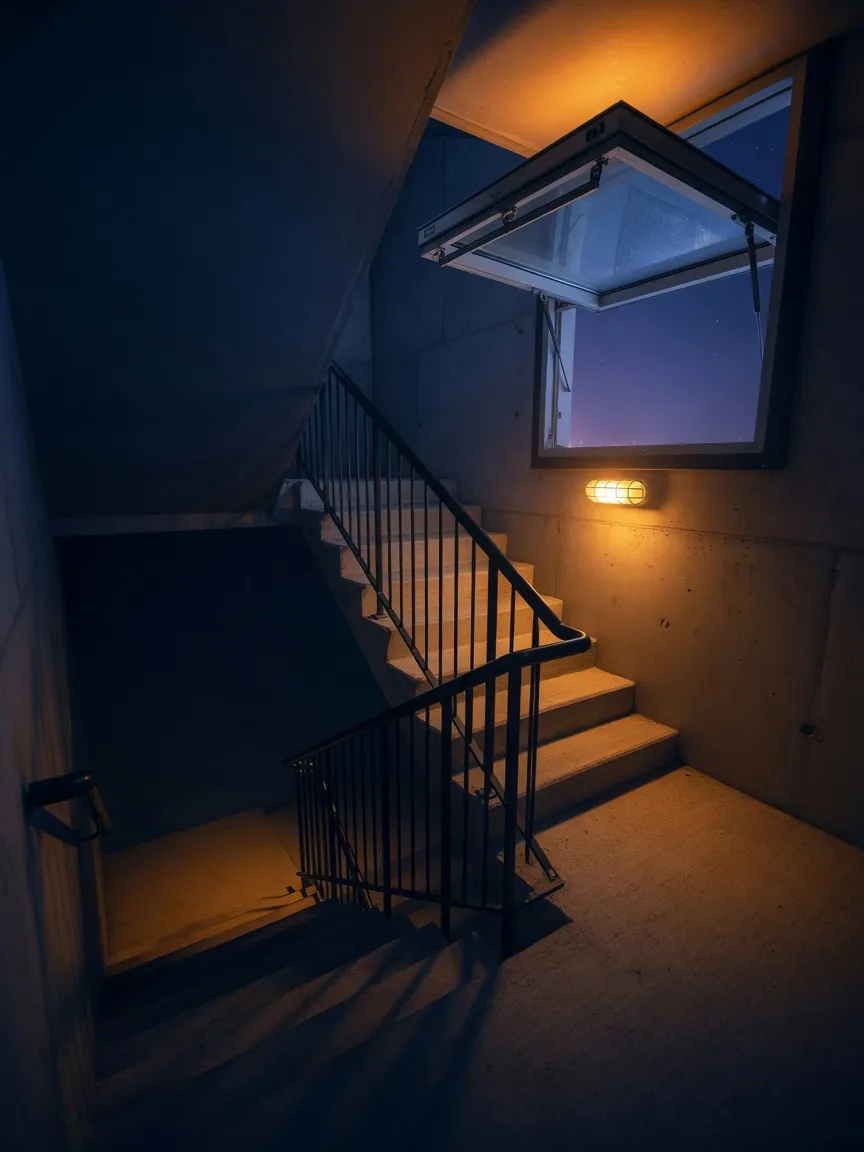
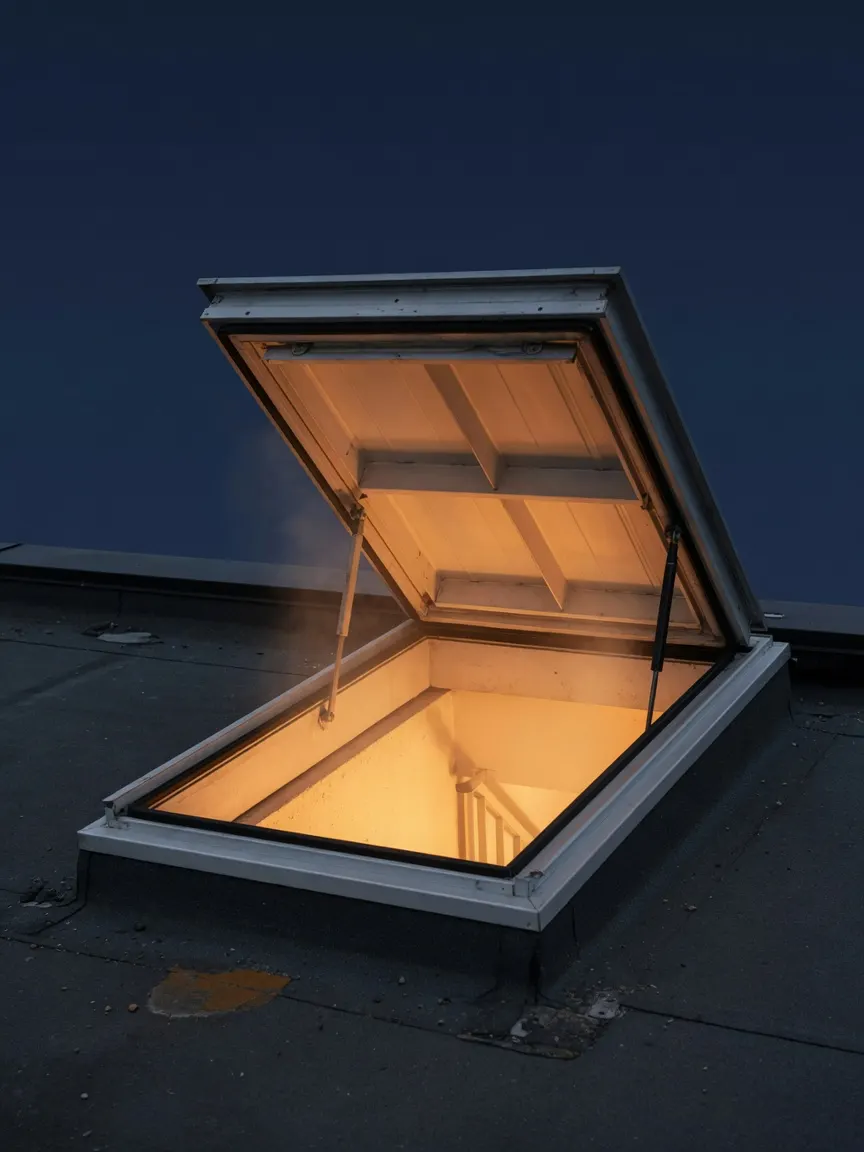

A smoke vent has one job, and it is not ventilation. When smoke hits the head of a staircase, the automatic opening vent at the top opens and keeps the escape route usable while people get out and firefighters get in. It sits there untouched for months at a time, which is exactly why the law attaches a testing regime to it: an AOV that has quietly failed looks identical to one that works, right up to the night it matters.
This article sets out what is actually required: who carries the duty, what the regulations say, how often smoke vents should be tested, and what the record needs to show. If you want the system itself explained first, start with our guide to how AOV smoke ventilation systems work.
Who carries the legal duty
Smoke control equipment in the common parts of a building falls under the Regulatory Reform (Fire Safety) Order 2005. Article 13 deals with the provision of fire fighting and fire detection measures, and Article 17 requires that facilities, equipment and devices provided for safety are “subject to a suitable system of maintenance” and kept “in an efficient state, in efficient working order and in good repair”. The duty sits with the Responsible Person: typically the building owner, landlord, managing agent or employer in control of the premises. Appointing a contractor does not move the duty. It is how you discharge it, and the records are how you prove you did.
High rise residential: monthly checks are now explicit
For high rise residential buildings in England, those at least 18 metres tall or with at least seven storeys, the Fire Safety (England) Regulations 2022 turned good practice into a named legal duty. Under regulation 7, the Responsible Person must carry out monthly routine checks of lifts for firefighter use, evacuation lifts and essential fire fighting equipment in the building. Government guidance lists smoke control systems among that essential equipment, alongside rising mains, detection and suppression.
Two further duties follow. If a fault is found and cannot be fixed within 24 hours, it must be reported to the local fire and rescue service, and reported again once repaired. And a record of every monthly check must be kept and made available to residents. A stairwell AOV in a high rise block is therefore not a fit and forget device in any legal sense: it is on a monthly clock, with a named audience for the paperwork.
The standards behind the regime
The Order and the 2022 Regulations say the equipment must work and be checked. The standards say what checking looks like.
- BS 7346-8 is the code of practice for smoke control systems, covering planning, design, installation, commissioning and, critically here, maintenance. It is the document a competent servicing regime is built on.
- BS EN 12101 is the product standard series for the equipment itself: natural smoke and heat exhaust ventilators, powered extract fans, smoke curtains and control equipment.
- BS 9999 and BS 9991, the fire safety codes for non residential and residential buildings, both treat smoke control as part of the package of measures a building’s escape strategy depends on.
How often should smoke vents be tested?
In practice a compliant regime has two layers, and they answer to different people.
Regular function checks by the building’s own team. A weekly simulated actuation, which is what BS 9999 Annex I asks of the building’s own staff: operate the vent from its control point, watch it open fully, watch it reset. In high rise residential buildings the monthly check is a legal requirement under regulation 7, as above. This layer catches the obvious failures: a vent that does not move, a control panel showing a fault, a battery indicator that has gone amber.
BS 7346-8 does not set its own calendar. It points routine inspection and maintenance at Annex I of BS 9999, which expects three things: the system’s actuation simulated every week by the building’s own trained staff (on large multi-zone installations the equipment tested can be rotated, provided every item is operated at least every three months); a full simulated actuation of every zone every three months; and an annual inspection and performance test by a competent person, with a certificate of testing obtained. BS 7346-8 adds what the competent-person visit has to prove: the agreed cause-and-effect, the changeover to secondary power within the time BS EN 12101-10 allows, standby equipment taking over when duty equipment fails, dated battery labels within the manufacturer’s life, and every fault-monitoring function exercised by simulating faults. Manufacturers’ schedules and the fire risk assessment sit on top of that, never underneath it.
The second layer is the one that fails silently when it is skipped. Actuators seize in place, backup batteries age past their capacity, and a vent that passed its button test can still fail on the day if the detection interface was never proven. Testing the vent without testing the cause and effect that fires it is half a test.
What the record has to show
An enforcing officer, a fire risk assessor or a building safety case reviewer will ask the same questions of your smoke control records:
- The date of every function check and every service visit, with what was operated and what was found.
- Faults, with the date identified, the date rectified, and for high rise residential buildings the date the fire and rescue service was told about anything outstanding past 24 hours.
- Evidence the fire alarm interface was tested, not just the vent in isolation.
- For higher risk buildings, where these records now feed the safety case under the Building Safety Act, who did the work and their competence to do it.
A gap in that record reads as a gap in the regime. In the prosecutions that reach the trade press, the recurring finding is not exotic equipment failure. It is a fault that sat on a panel for months with nobody able to say when it appeared.
How Gemini AMPM can help
Gemini AMPM services and maintains AOV and smoke extract systems as life safety equipment: planned maintenance to BS 7346-8, fault diagnosis and repair, replacement actuators and controls, and testing that includes the fire alarm interface rather than stopping at the vent. Where the same visit can cover fire damper testing in the ductwork, one contractor leaves one set of records with no gaps between trades. And if the paperwork is the worry rather than the plant, a fire risk assessment will tell you what your building’s regime should look like before an inspector tells you what it should have looked like. Call 0330 043 0080 or get in touch to put a test date in the diary.