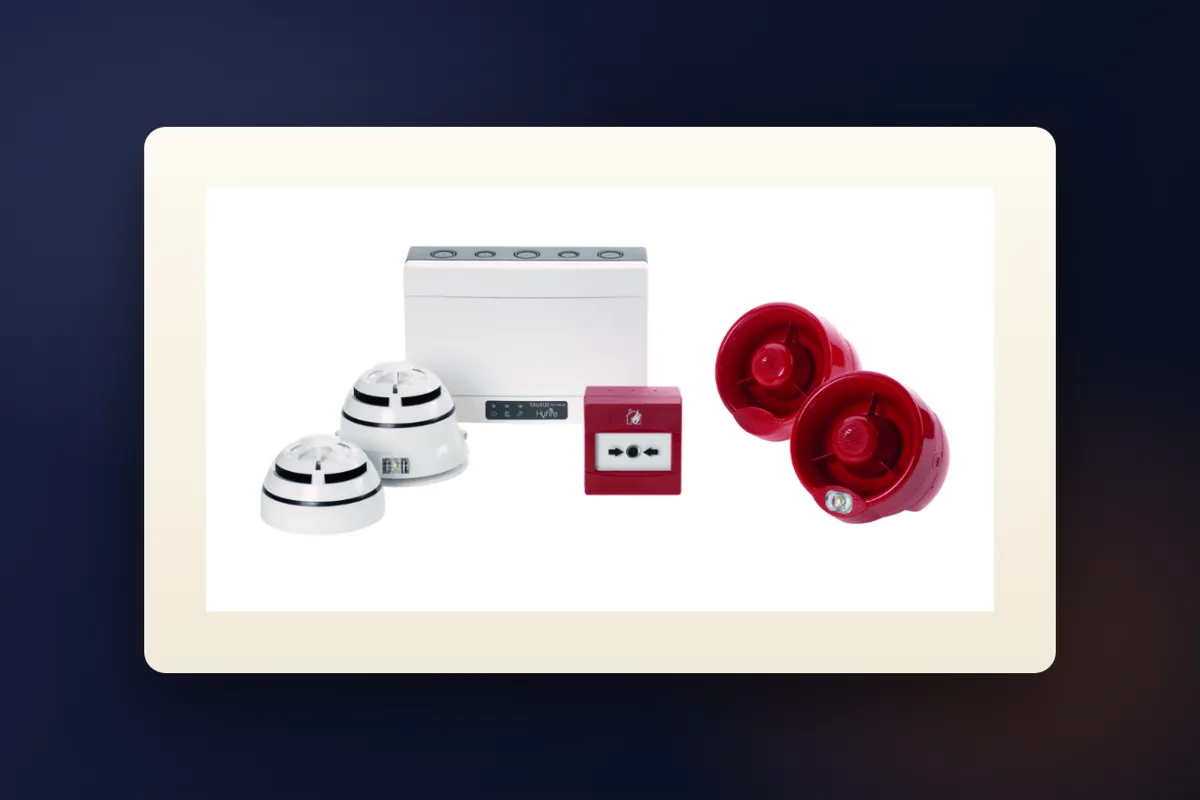
Every wireless versus wired costing starts in the same place: a hardware schedule with a wireless column that looks expensive. A radio-linked detector with a supervised battery and BS EN 54-25 certification costs more than its wired equivalent, point for point. Put the two device schedules side by side and wired wins every time.
Then the installation starts, and the comparison inverts. A wired fire alarm is mostly not devices. It is fire-rated cable, containment, chases cut into walls, ceiling voids opened, floors lifted, fire-stopping reinstated and every surface made good afterwards. Most of that is labour, and labour is exactly what a wireless system removes.
We have already published a decision guide on when wireless beats wired, building type by building type. This article is the money half of the question: what each route really costs, where those costs hide, and how to compare two quotes that are built in completely different shapes.
Where the money sits in each system
A commercial wireless fire alarm system concentrates its cost in the kit. Every device carries its own radio, its own supervised battery and its own EN 54-25 certificate, and you pay for that at every point on the schedule. Installation, by contrast, is two fixings and a pairing routine: no cable runs, no containment, no making good. Full systems are typically commissioned in days rather than weeks.
A wired system spreads its cost the other way. The devices are cheaper, but every one of them needs fire-rated cable run back through the building, and in an existing building that means chases, lifted floors, opened ceilings, penetrations through compartment walls that have to be fire-stopped again, and redecoration afterwards. On an occupied-building retrofit, the devices themselves can end up a minority of the final account.
Neither shape is wrong. But it is why comparing hardware schedules tells you almost nothing, and why the honest comparison is installed cost plus whole-life cost, never kit price.
The comparison, line by line
- Hardware per device. Wired: lower. Wireless: higher, paying for the radio, the supervised battery and EN 54-25 certification on every point.
- Installation labour. Wired: the dominant cost, in cable, containment and making good. Wireless: a fraction of the wired figure, two fixings and pairing per device.
- Programme length. Wired: weeks to months in an existing building. Wireless: days, moving floor by floor around your operation.
- Disruption and making good. Wired: ceilings opened, floors lifted, redecoration to follow. Wireless: no chases, no lifted floors, no redecoration bill.
- Consents in listed buildings. Wired: Listed Building Consent and conservation sign-off for cable routes. Wireless: usually avoided entirely.
- Batteries over the system life. Wired: none. Wireless: planned replacements, folded into routine service visits.
- Changes, moves and extensions. Wired: recabling, containment and making good every time. Wireless: new devices pair to the panel in minutes.
- Routine maintenance. Six-monthly to BS 5839-1 on both routes, with battery state checked at each visit on wireless.
Design, commissioning and certification cost broadly the same on either route, because they are the same job. A wireless system is still a BS 5839-1 system, with the same categories, the same spacing rules and the same certificates at handover.
The costs that never appear on the quote
Three cost lines decide most real comparisons, and none of them sits on a hardware schedule.
Disruption. A wired retrofit in an occupied office, hotel or residential block means ceiling voids opened above people while they work, or night and weekend working at premium rates, or floors decanted while the cable goes in. A wireless installation goes in around daily life, floor by floor, which is why occupied and phased sites suit wireless so well.
Making good. Redecoration, matched finishes and reinstated fire-stopping are habitually under-quoted on wired retrofits, and badly reinstated fire-stopping is not just a cost, it is a compliance liability in its own right. Wireless leaves nothing to make good.
Programme time, when time is money. The sharpest example is waking watch removal, where the interim cost typically runs at £8,000 to £15,000 per month for a single mid-rise block. Every week a slow retrofit adds to the programme is paid in cash. At the Unity Building in Liverpool, eight engineers fitted more than 1,000 wireless devices across 26 storeys and 161 apartments in four weeks, ahead of schedule and to budget, and the waking watch was stood down. No plausible saving on device prices survives arithmetic like that.
The whole-life view: batteries versus recabling
Here is the honest part of the wireless case: it carries a recurring cost that wired does not. Every device runs on batteries, with typical lives of 5 to 10 years on detection devices and 3 to 5 years on sounders. On a 500-device estate that means roughly 50 to 100 battery replacements a year, every year. EN 54-25 requires a low-battery fault at least 30 days before a battery can no longer support its device, and modern platforms warn months out, so replacement becomes a planned line inside routine six-monthly maintenance rather than emergency callouts. It is a real number, and any wireless bidder should price the battery schedule across ten years.
Wired systems have a recurring cost of their own, and it hides under a different heading: change. Commercial buildings churn. Tenancies turn over, mezzanines appear, floors are reconfigured, and every change to a wired system is a fresh round of cable, containment and making good, sometimes with part of the building closed. On a wireless system the same change is a purchase order and a pairing routine, done in minutes per device.
Which recurring cost is bigger depends on the building. A static estate with easy access favours wired over the long run. A building that changes shape every few years pays for its wired system twice. The two routes can look similar at year one and sit far apart at year ten, which is why the ten-year figure is the one to ask for.
Where wired still wins on cost
New construction. If detection goes in during first-fix electrical works, the labour cost of running fire-rated cable alongside the rest of the install is negligible, and the wireless hardware premium buys you nothing. In new build, wired remains the cleaner default unless heritage, phasing or another specific driver applies.
Very large, very dense estates. Wireless mesh networks have practical scale limits, and a dense multi-hundred-device campus sits at the edge of what radio infrastructure handles without compromise. Wired networks scale linearly.
Constrained-access 24/7 environments. Where every visit needs a shutdown window, the access cost of 50-plus battery replacements a year adds up. Wired has no equivalent recurring access cost.
High-RF environments. Broadcast facilities and industrial RF-heavy plants can defeat the licence-exempt band wireless systems rely on. Wired is immune by design.
The hybrid option nobody prices
This is rarely a binary choice. Modern platforms are hybrid-capable: radio translators sit on a wired loop to the addressable panel, with up to 128 wireless devices per translator and 240 per hybrid loop. That means a wired building can take a wireless extension when the mezzanine, annexe or new tenancy appears, without closing part of the building to run cable, and a mostly-wireless design can run cable to the one deep basement or metal-lined plant room that genuinely defeats radio. The cheapest system for many buildings is both.
What we would recommend
When two quotes land on your desk, make them comparable before you compare them:
- Compare installed cost, never hardware schedules. Demand the same breakdown from both bidders: devices, labour, containment, making good, programme length.
- Price the disruption into the wired number. Out-of-hours premiums, decanted floors, lost trading, and interim measures such as a waking watch for every week of programme.
- Ask both bidders for the ten-year figure. Batteries and planned replacement on one side, realistic change and recabling costs on the other.
- Insist on a radio survey before any wireless price is fixed. An installer who prices radio without measuring signal strength through your actual walls and floors is guessing, and the guess becomes your problem at commissioning.
- Check the certification reads identically. EN 54-25 devices, BS 5839-1 design, and a third-party certificated installer: our work is delivered under BAFE SP203-1 registration.
We install both technologies and pick on the merits of the building, not the margin. For occupied buildings, heritage stock and waking watch removal, wireless is now almost always the cheaper system once disruption and programme are priced honestly. For new build and large static estates, wired usually remains the cheaper route. If you want the comparison run properly on your building, our wireless fire alarms page covers what a compliant radio design involves, or call 0330 043 0080 and a named engineer will come back within 24 hours.
This article is general guidance. Specific fire alarm system design and costing must be undertaken by a competent designer working to BS 5839-1:2025 and the fire risk assessment for the building.