On 16 July 2026, Prestleigh Inn B&B Limited was ordered to pay £33,700 at Taunton Magistrates’ Court after pleading guilty to four offences under the Regulatory Reform (Fire Safety) Order 2005. The total was made up of a £26,000 fine, a £2,000 victim surcharge and £5,700 in prosecution costs, with the court allowing payment in thirds over three years.
The prosecution was brought by Devon and Somerset Fire and Rescue Service after a guest complained. When inspectors visited the five bedroom guest house, they found no fire risk assessment, a fire alarm system that was not working and showing nine faults, defective fire doors, and no evidence of regular maintenance for the alarm, the emergency lighting or the fire-fighting equipment. Two prohibition notices were served at the inspection, stopping the premises being used for sleeping accommodation until remedial work had been carried out (Fire Protection Association).
The company has since put the position right. The remedial work was done, a further visit in March 2026 found the fire safety arrangements adequate, and the court heard that the company director had completed an IOSH risk management course.
That matters to how you read what follows. This is not about one business that has since fixed its systems. It is about how a court treated the findings, and what that says to everyone who has not yet been inspected. The detail worth your attention is where the money landed.
What this means for your building
The biggest single fine was for the paperwork, not the hardware. The Article 9 breach, the failure to make a suitable and sufficient assessment of the risks, drew £16,000. The Article 13 breach covering fire-fighting and fire detection drew £10,000. The remaining two offences, Article 14 (means of escape, covering the defective fire doors and the emergency lighting) and Article 17 (maintenance), attracted no separate penalty. Courts commonly load the lead offence and mark the rest that way, so read the split as sentencing structure as much as a league table. It is still worth noticing which offence the court treated as the lead one. Most building owners assume the equipment failure is the serious matter and the missing document is an administrative slip, and the sentence does not read that way.
The fire risk assessment is the root document: it sets the alarm category, the emergency lighting design, the evacuation strategy and the maintenance regime. Without it, nothing downstream has a justification. If you are not sure yours would survive that test, we run a free second opinion review of your fire risk assessment.
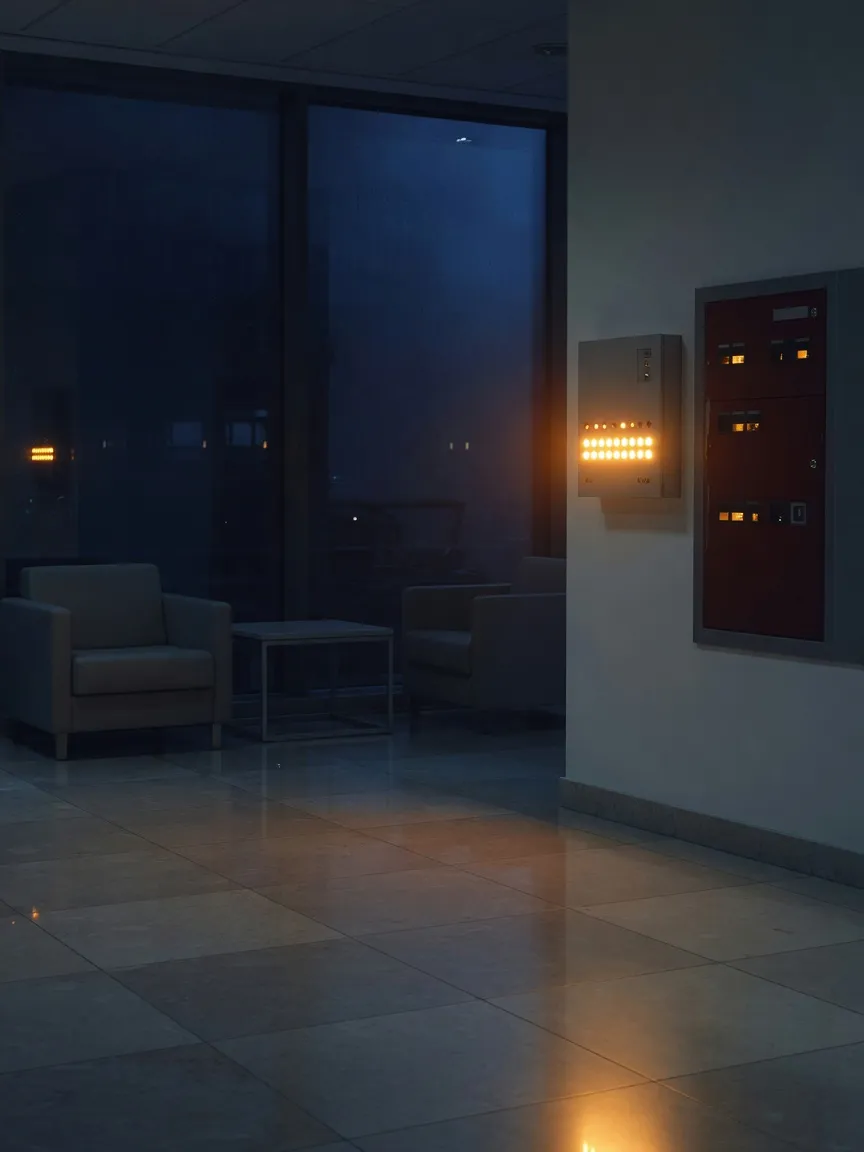
A fault on the panel is not a hidden defect. It is a visible one. A fire alarm panel in fault condition announces itself. It has an amber lamp, an audible reminder and a timestamped event log. When an inspector arrives, that log is the record of how long the system has been degraded, and it speaks for itself. Compare that with a building where faults are raised, attended and signed off: the same log becomes the strongest evidence you have that the system is being managed. The panel writes the story either way. You decide which one.
A system in fault is not a system in service. If a detector is isolated, a zone is disabled or a sounder circuit is open, the coverage described in your fire risk assessment no longer exists in the building. “The alarm was fitted” is not the test. Article 17 of the Order requires that fire precautions are subject to a suitable system of maintenance and are maintained in an efficient state, in efficient working order and in good repair, and BS 5839-1:2025 expects that to run as a documented service regime rather than an occasional visit.
Three separate maintenance regimes, and no evidence for any of them. Inspectors did not just note that the alarm was broken. They found no evidence of regular maintenance for three separate things: the fire detection and alarm system, the emergency lighting and the fire-fighting equipment. Those are three different service regimes with three different standards behind them, and building owners routinely hold evidence for one and assume it covers the others. Emergency lighting in particular gets forgotten, and BS 5266-1:2025 is now the current code of practice, having replaced the 2016 edition in October 2025.
The prohibition notice is the real commercial risk, not the fine. The £33,700 arrived in July 2026 for an inspection carried out in May 2025. The prohibition notices were served at that inspection, more than a year earlier, and they stopped the premises being used for sleeping accommodation until the remedial work was done. For a hotel, a care home, an HMO or a supported living scheme, losing the ability to accommodate people removes the core revenue line while the costs keep running, and it happens long before any court date is set. The enforcement ladder runs from informal advice through notices to prosecution, and we set out how it now works in our note on the July change to the Fire Safety Order enforcement guidance.
The trigger was a member of the public. Not a scheduled audit. A guest complained. Tenants, staff, visiting contractors and residents can all start this process, and sleeping-risk premises are where fire and rescue services concentrate their enforcement attention.
What to check on your own panel this week
- Walk to your fire alarm panel today. Is there a fault or disablement showing? If yes, find out how long it has been there. That single answer tells you whether your maintenance arrangement is working.
- Open the logbook and look for closure dates. A fault that is raised and then signed off is evidence the system is managed. A list of entries with nothing closed is the opposite.
- Check you hold three sets of certificates, not one. Fire detection and alarm servicing against BS 5839-1:2025, emergency lighting against BS 5266-1:2025, and extinguisher servicing. Different disciplines, separate evidence.
- Confirm your emergency lighting testing actually happens. A brief function test at intervals not exceeding one month, and a full rated duration test annually, usually three hours. The 2025 edition also adds photometric verification at intervals not exceeding five years, so check whether yours has ever had one. Recorded every time.
- Close the fire risk assessment actions, not just the assessment. We set out the wider documentation checklist when the Fire Safety Order enforcement guidance changed in July.
- Look at your fire doors properly. Closers that do not shut the door onto the latch, gaps you can post a coin through, and damaged or missing seals are all visible in a five minute walk round.
How Gemini helps
A maintenance contract is only worth anything if faults get attended and closed out, not just logged. That is what our fire alarm service and maintenance contracts are built around, and fire alarm remedial works clears the backlog on a system that has been left. We maintain fire detection and alarm systems to BS 5839-1:2025 under our BAFE SP203-1 registration (certificate 102640, third party certificated by NSI). The fire risk assessment is the root document every other part of the fire strategy depends on, and we can introduce an independent assessor we have worked with for years. We also service fire extinguishers and survey fire doors, so the evidence pack comes from one place.
If there is a fault sitting on your panel right now and you are not sure who owns it, call 0330 043 0080.
This report is based on published accounts of proceedings at Taunton Magistrates’ Court on 16 July 2026, reported by the Fire Protection Association and the North Somerset Times. If anything here is inaccurate or out of date, contact us on 0330 043 0080 and we will correct it.