Today we are publishing the London False Alarm Index: a count of every automatic fire alarm (AFA) false alarm London Fire Brigade attended from 2019 to 31 July 2026, by borough, by type of building and by time of day. It is built from the Brigade’s own incident records, which it publishes as open data on the London Datastore. The borough table is free to download and the method is published in full.
We built it so that anyone who runs a building, or writes about fire safety, can see the scale of the problem in the Brigade’s own numbers, borough by borough.
The headline numbers
- London Fire Brigade attended 47,038 automatic fire alarm (AFA) false alarms in 2025, an average of 128.9 a day. That was 34.1% of the 137,981 incidents it attended and 76.2% of its 61,751 false alarms.
- That is about one every 11 minutes, all year.
- AFA false alarms attended in London numbered 41,477 in 2019 and 47,038 in 2025. The highest year from 2019 to 2025 was 2024 with 51,625. The 2025 total was 4,587 lower than 2024 (-8.9%).
- So far in 2026 (1 January to 31 July 2026) the Brigade has attended 28,591, against 26,001 in the same dates of 2025 (+10.0%).
The policy change is visible in the data
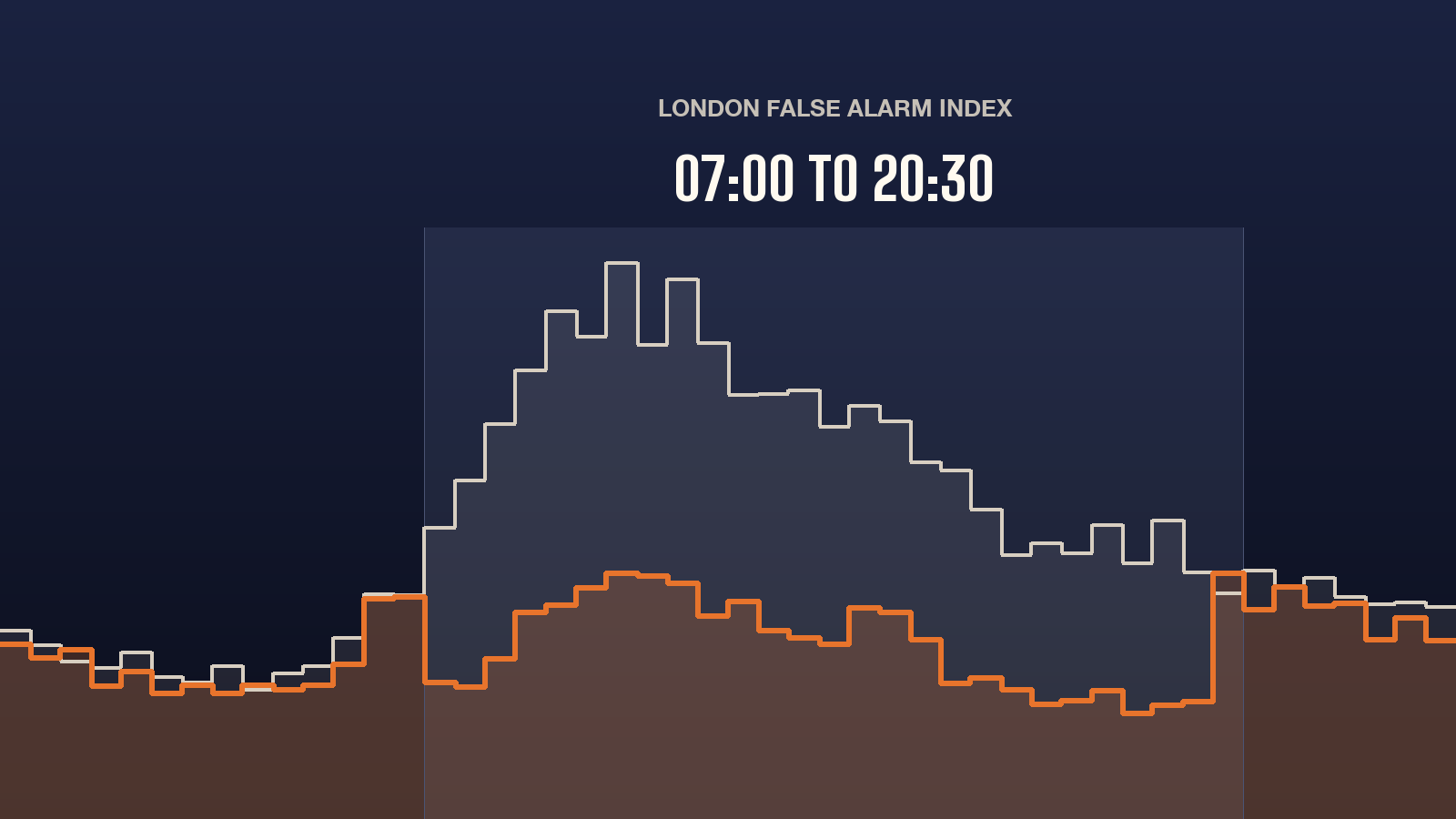
On 29 October 2024 the Brigade changed how it responds. Between 07:00 and 20:30 it no longer attends an automatic fire alarm at most non-residential buildings unless a person also calls 999 to report a fire. Homes, hospitals, schools, care homes and the other premises on its exemption list still get a response at any hour.
In the year before the change the Brigade attended 13,713 AFA false alarms at non-residential buildings in those hours. In the year after it attended 6,396, a change of -53.4%. At hospitals, schools, nurseries, prisons and young offenders’ units, which are exempt, the figure moved from 2,965 to 2,726 (-8.1%). At all other non-residential property types it went from 10,748 to 3,670 (-65.9%).
One caution matters more than any number here. These are incidents the Brigade attended, not alarms that sounded. An alarm it did not attend is not in the data. So the records show a fall in attendance. They do not show that alarms went off less often. What they do show is that, in a non-exempt building in the daytime, finding out why the alarm sounded is now the building’s job.
Most false alarms are at homes
By property category, 30,932 of the 2025 AFA false alarms (65.8%) were at dwellings, 11,211 (23.8%) at non-residential properties and 4,864 (10.3%) at other residential properties such as care homes, hostels, hotels and student halls. The single largest property type was “Purpose Built Flats/Maisonettes - 4 to 9 storeys”, with 8,426.
Residential buildings are outside the daytime policy, and residential AFA false alarms went from 33,729 to 35,232 (+4.5%) between the year before the change and the year after. The data does not say why.
Borough by borough
The Index ranks all 33 areas, the 32 boroughs and the City of London, each with its own page. The most in 2025: Westminster (4,248), Camden (2,655), Kensington and Chelsea (2,369). The fewest: Kingston upon Thames (560). The counts are not adjusted for population or for the number of buildings, so a borough with more buildings will tend to have more.
Non-residential AFA false alarms attended between 07:00 and 20:30 were lower in the year after the change than in the year before in 33 of the 33 areas (32 boroughs and the City of London). The largest fall in number was in Westminster, from 1,978 to 915 (-53.7%). The largest percentage fall was in Kingston upon Thames, from 223 to 66 (-70.4%), and the smallest percentage change was in Greenwich, from 332 to 242 (-27.1%).
What to do with it
If you manage a commercial building that is not exempt, the practical points are the ones the Brigade sets out in its guidance note on managing and reducing false alarms: a safe way for trained staff to investigate an alarm, a 999 call the moment there is any sign of fire, a fire risk assessment and emergency plan that reflect the change, and a clear routine agreed with your alarm receiving centre. If you manage a residential block, the Brigade still attends, so the work is in finding and removing the causes. The Index sets out both in what this means if you manage a building.
If you write about fire safety, the charts are free to reuse with a credit, and the borough table is a plain CSV.
How Gemini AMPM can help
False alarms are an engineering problem before they are a statistics problem. Our fire alarm maintenance visits review the activation history every time, so a detector that keeps tripping is dealt with and not just logged. Fire alarm monitoring puts a verification call between the panel and a 999 call. Where the cause is the wrong device in the wrong place, remedial works covers the change. We do not carry out fire risk assessments, but we can introduce independent assessors we have worked with for years.
To talk about the alarms in your building, request a consultation or call 0330 043 0080.
Source: London Fire Brigade, London Fire Brigade Incident Records, published on the London Datastore (data.london.gov.uk). Contains public sector information licensed under the Open Government Licence v2.0. The Greater London Authority cannot warrant the quality or accuracy of the data. This analysis is by Gemini AMPM. It is not endorsed by, affiliated with or approved by London Fire Brigade or the Greater London Authority. Full sources and method: London False Alarm Index methodology.